
Once in a while, I have this illusion that I’m well-equipped enough to write a more data-journalistic piece. Don’t worry, the urge will probably sink as soon as it came up, but I want to take advantage of the opportunity. So let’s talk about zone 14 and whether its relevance has changed in the last 5 seasons.
But let’s stop right there for a moment. I have been thinking a lot about writing about football analysis, whether that’s video, data or engineering, and I need to get a few things off my chest.
The first thing I think that needs addressing is that in the football sphere online, opinions are more and more presented in a way that they are stated to spark controversy. It’s either black or white, and in doing so, it sparks fuel to a very polarising view of football. We have seen this in how people say “this is the right way to play football” which also leads to remarks that there is something like “anti-football”. I think that’s very harmful because it portrays the idea that football should be played, viewed and analysed in a specific way, otherwise it isn’t valid.
Building on that, if we look at the analysis part of things, I came across a specific, well-written essay featured on Spielverlagerung.
One of my favourite writers at the moment, Hamzah Khalique-Loonat, alerted me to this piece, and I’m very happy he did, because it’s of vital importance in the way we see football. Personally, I think there is an issue with portraying rights and wrongs too in football, because in the end, they are all human constructs. And, I also agree with the notions that we can present our ideas as universal truths or paths to get somewhere. I have been guilty of this thing as well. You can read the essay here: https://spielverlagerung.com/2026/02/06/essay-escape-mx/
The next thing that worries me as well is more of a global trend in sports journalism. More and more cuts happen at qualitative newspapers and news outlets. This is a worrying state, because it feeds into the undermining of democracy in various nations all over the world. And it has the consequence that there are fewer journalists and more writers. There is a distinction and we can see this mostly in the fact that more and more writers launch medium or substack (yes, I can see the irony of me writing this) because they have to, to survive. The issue I have with that is that there is no feedback, no editor or pushback. You write and you publish what you ought to be good. I’m not a journalist in this industry and it’s not my priority in life, but the quality of football (data) journalism needs it.
So how does this tie in with me writing an article about the evolution of zone 14? I recognised a pattern in myself that I set out to have a research question and from that question I hoped to see a certain outcome. That outcome never came and I wanted to manipulate the question so I could find some meaningful change. But the reason I wanted to do that is rather selfish, because I wanted to feel the validation of many readers or engagement. But that in itself is a bit of a problematic view.
With this context, it will be easier to understand that sometimes a lack of result, is also a result and I want to go back to better research when writing this more data journalistic pieces.
What is zone 14?
We can divide the pitch into different zones away from the thirds (defensive, middle and attacking third) and create a pitch that has 18 zones. In that zone, we identify zone 14 as the zone in central area just before the penalty area, as you can see here:
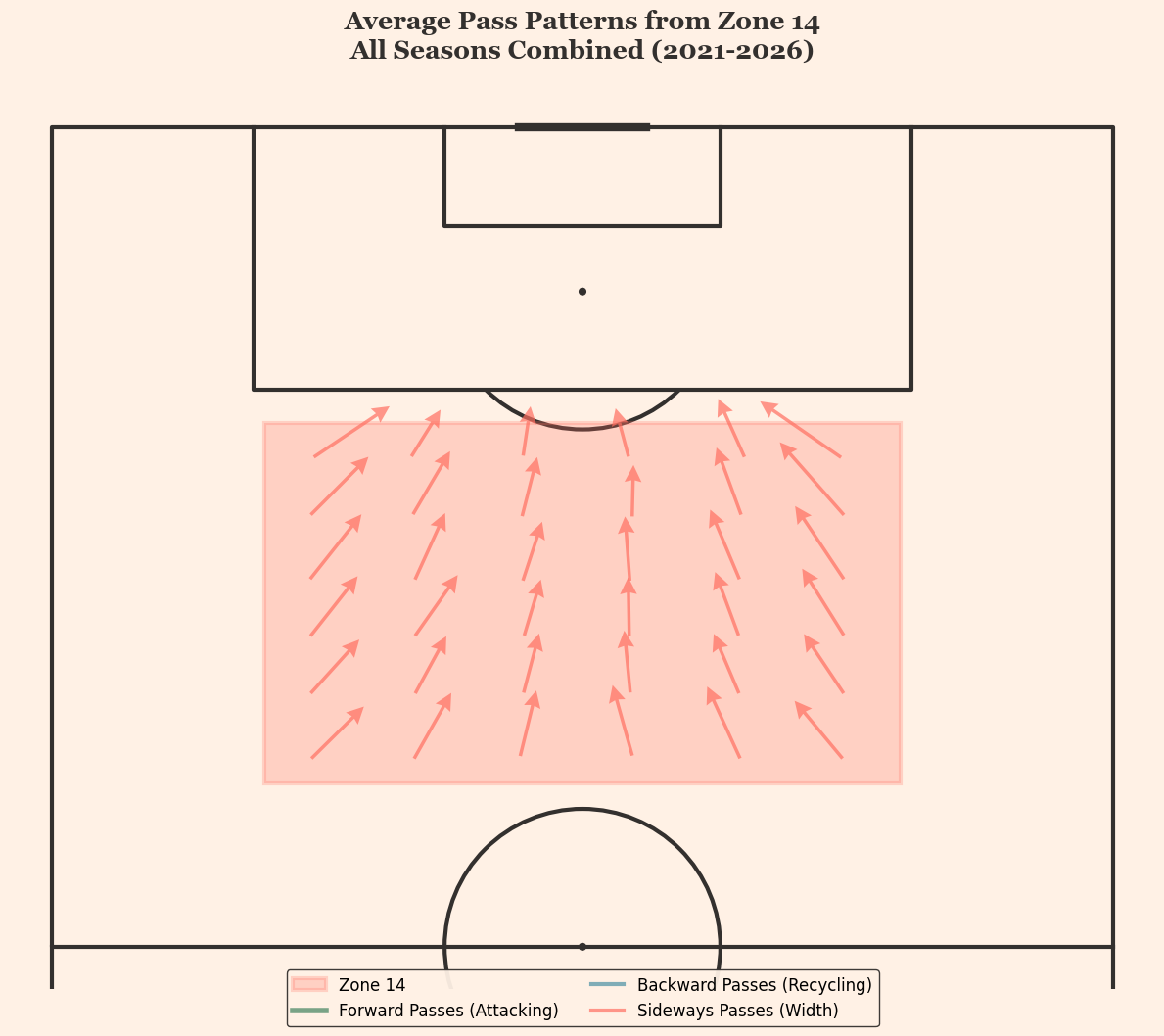
Why have we identified this zone and used it frequently over the last few years? It was researched in 2002 that passes into the penalty area from this zone were 4 times more likely to lead to a goal, rather than coming from either the left or right flank.
Successful players and teams were more likely to use zone 14 to get the ball into the penalty area than they were from the flanks. There is a strong correlation between zone 14 usage and success. This research stems from 2002 and in this article I will attempt to answer a two distinct questions in 2026:
- Does the ratio hold up in 2026?
- Have we moved from a creating zone to a connector zone?
Data
I have used 5 season of Premier League football to analyse. The seasons are: 2021–2022, 2022–2023, 2023–2024, 2024–2025 and 2025–2026. This data was pulled from the Wyscout API on February 4th, and it’s event data. From that event data.
I focus on the Premier League, because I think it will be interesting to follow an elite league and the feeling that I have that zone 14 is used a lot. I’m saying a feeling, so this is just based on intuition.
Ratio anno 2026
So how does it hold up in 2026? Are we still talking about 4 times higher ratio from zone 14 into the penalty area? Or has something changed. A good indication would be to see what the percentages have been throughout the years.
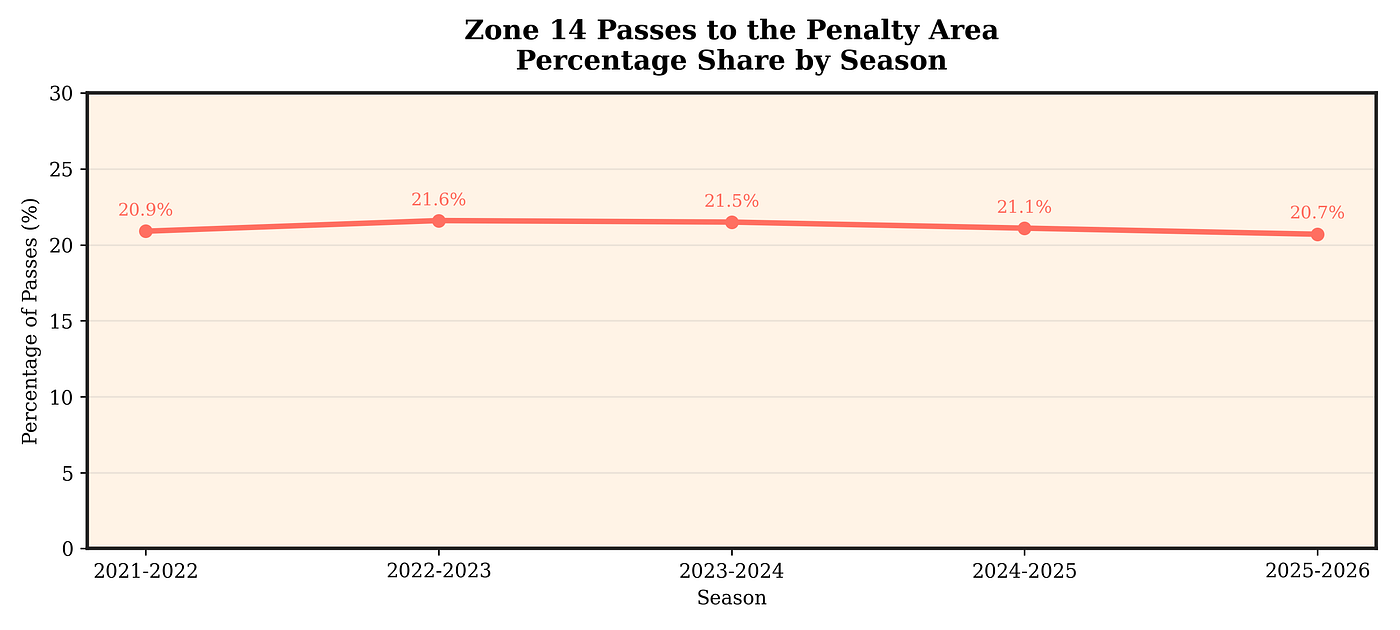
As we can see above, the percentage of passes to the penalty area from zone 14 remains more or less the same. The percentage starts with 20,9% in 2021–2022 after COVID and is currently on 20,7%. This 0,2% less than a few seasons ago, but the change is almost nihil. What’s interesting though is that it’s being smaller since 2022–2023.
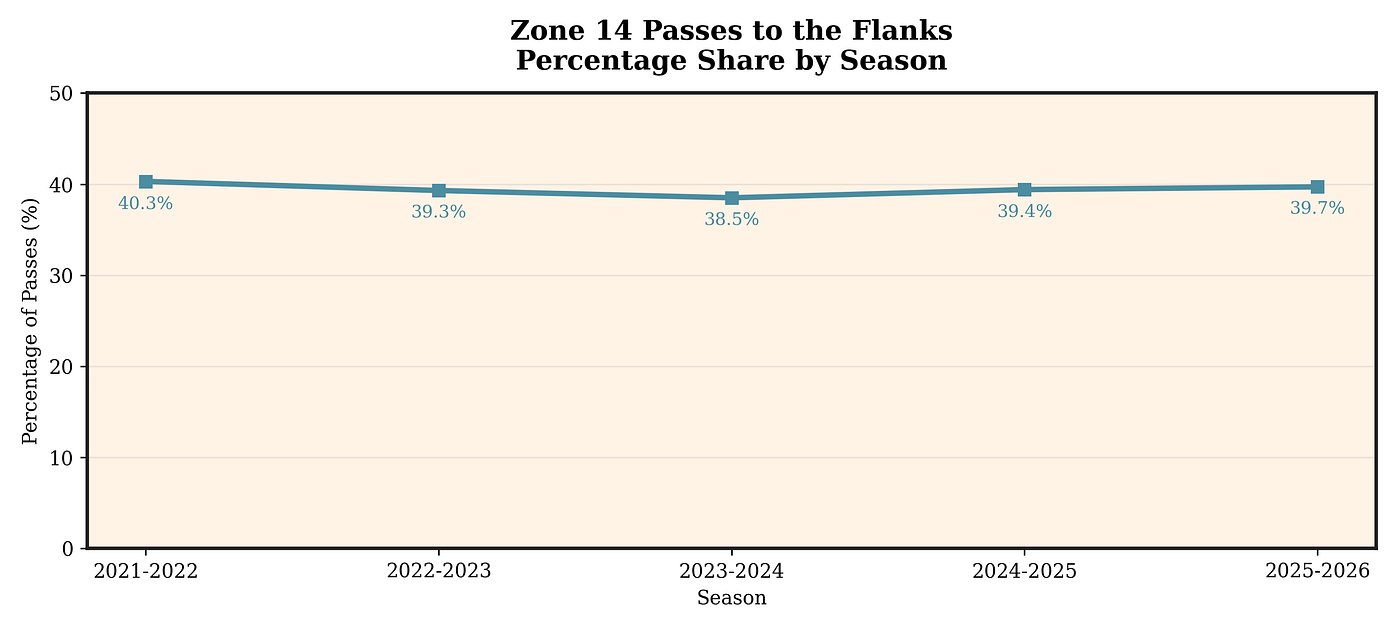
Something similar we can see in the percentages of going to the flanks. It was 40,3% at the beginning and dropped to 38,5% in 2023–2024 and is starting to climb again with currently 39,7%.
It shows us that there is a decline in zone 14 passes towards the penalty area and a slight growth in zone 14 passes to the flanks. This is obviously interesting, but now we want to see what it leads to: goals.
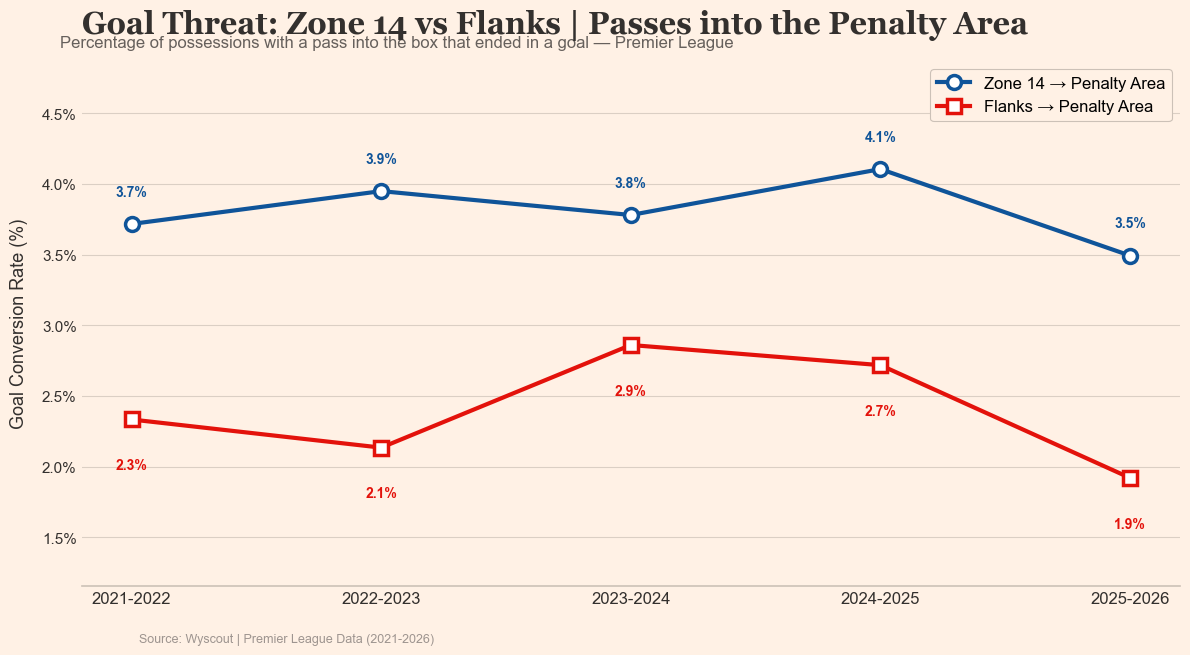
When we look at the percentage of goals from zone 14 into the penalty area, we see that 2024–2025 was the highest with 4,1% and the current season is the lowest with 3,5%. The flanks, however, had the highest percentage in 2023–2024 and are currently the lowest with 1,9%.
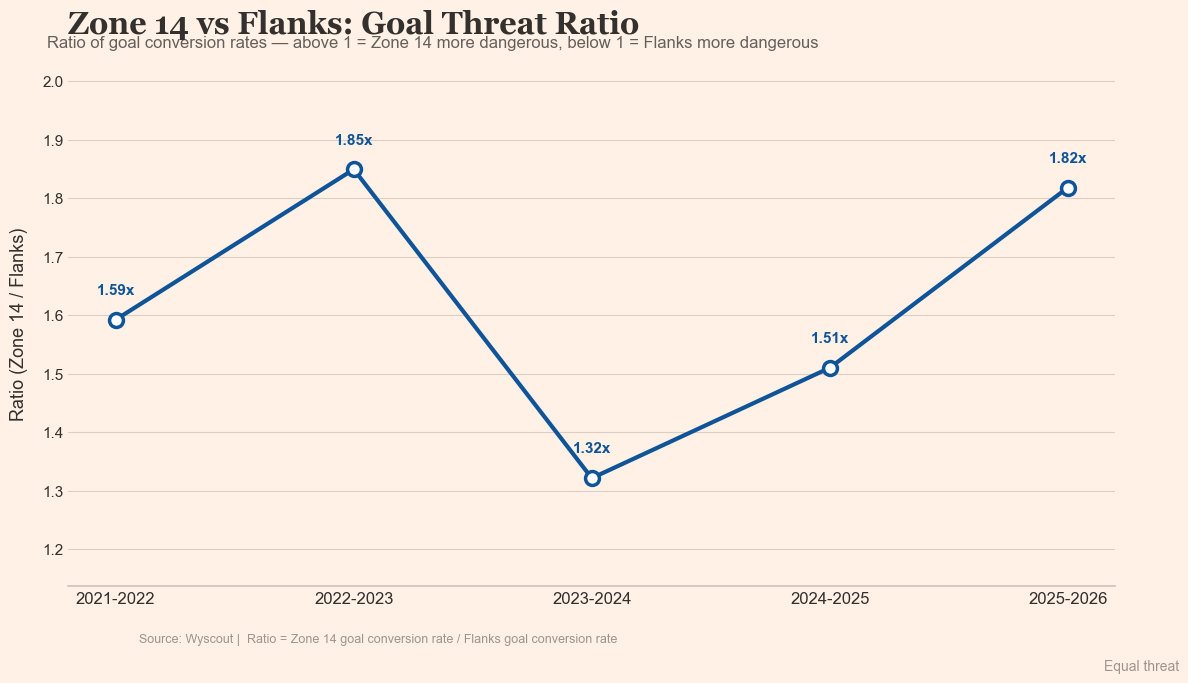
When we look at the graph above, we can see the ratio between zone 14-initiated goals and flanks-initiated goals. Nowhere in the last seasons has the ratio been four times higher from zone 14 than it is from the flanks. At it’s highest point, zone 14 has 1,85 times more success and it’s lowest point 1,32 times. Currently, the goal ratio is 1,82 times higher and that seems like zone 14 does deliver success.
From creation zone to connecting zone?
From watching games, I got the impression that zone 14 hasn’t been as much of a creation zone but more of a connecting zone. What I mean by this is that I think that fewer key passes come from this zone, but more passes that build the attacking in the latter phases of the sequences.
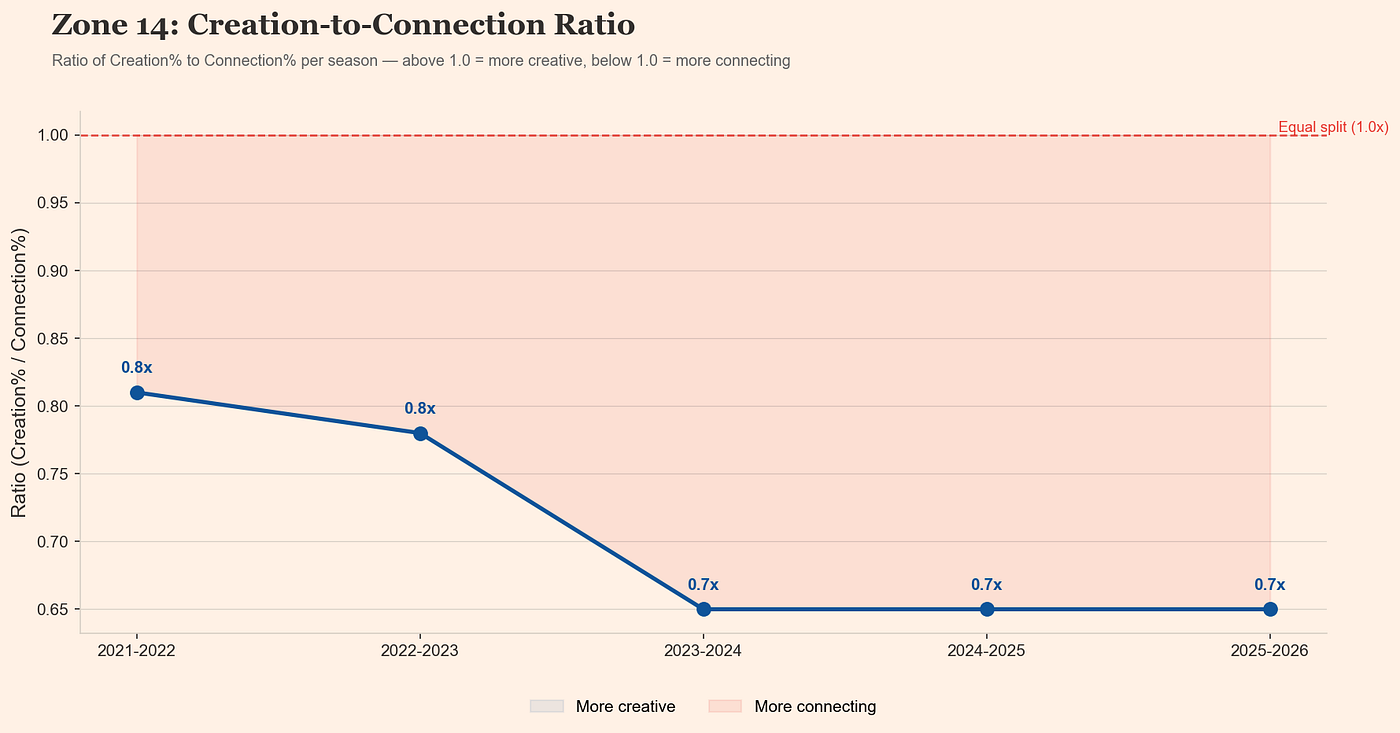
Looking at the last few Premier League seasons the connection from zone 14 is higher than the creation, meaning that there are less direct threat creation actions from passes. It started with 0,8 times and it’s now 0,7 times based on creation.
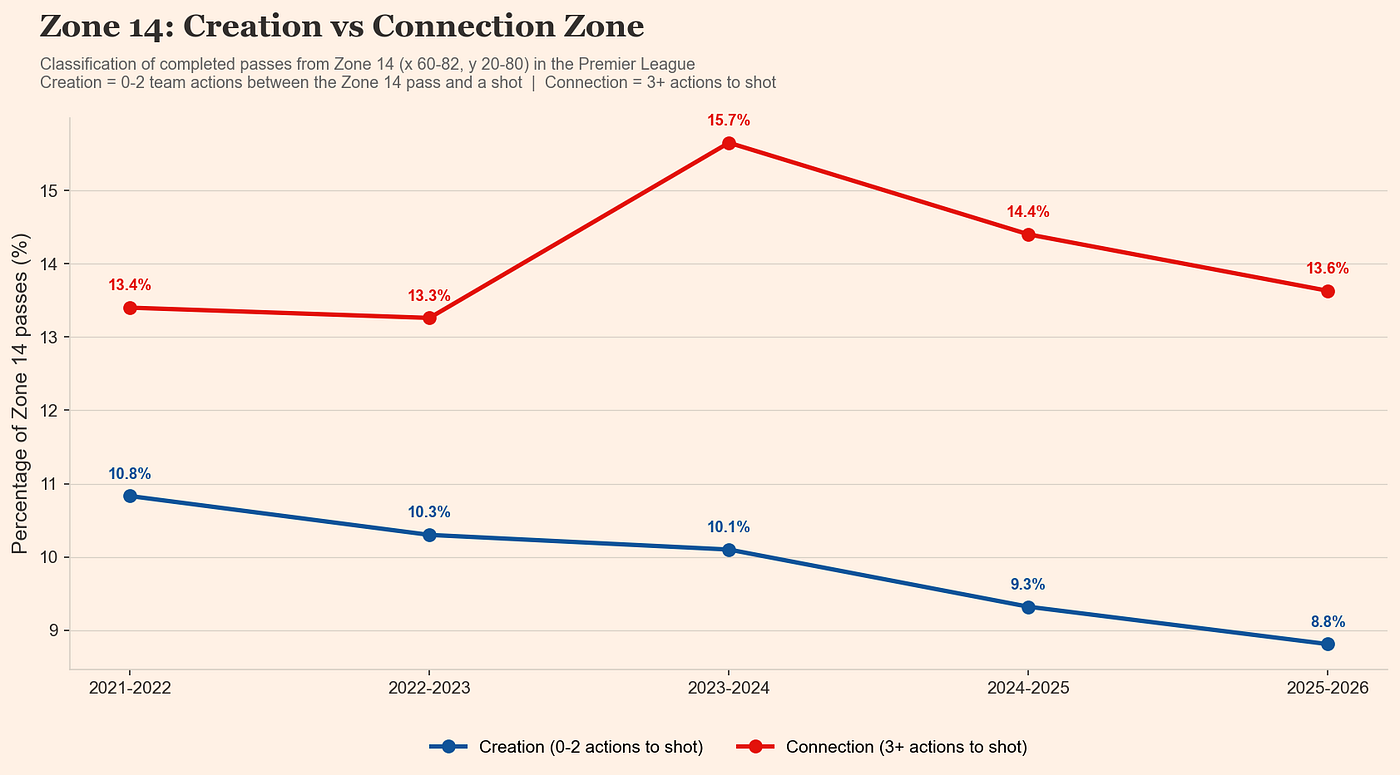
As you can see here, in the Premier League, 2022–2023 saw a spike in connecting through zone 14, but has also declined since and it’s 13,6% now. Creation has started at 10,8% but has just declined since and is at 8,8% now, which is -2%.
It would seem that in the Premier League over the last few seasons, zone 14 is more used a connection zone than a creation zone.
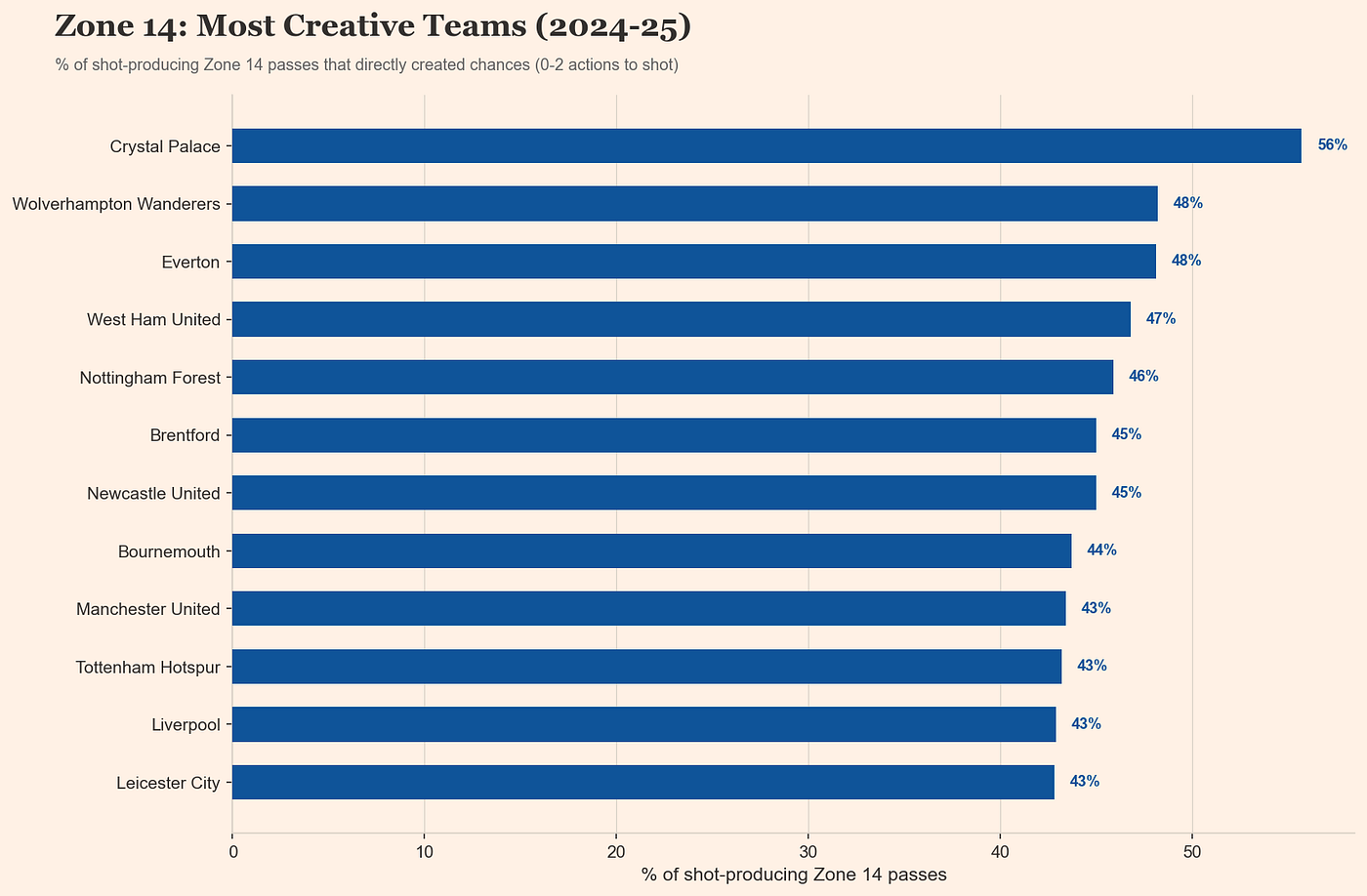
In the 2024–2025 season, the teams that created the highest percentage of shot-producing passes were Crystal Palace, Wolverhampton Wanderers and Everton. It meant that they were quite direct from the zone 14 and the shot that followed within 2 actions.
When we look at the connection zone 14 passes, we get to see different teams doing well.
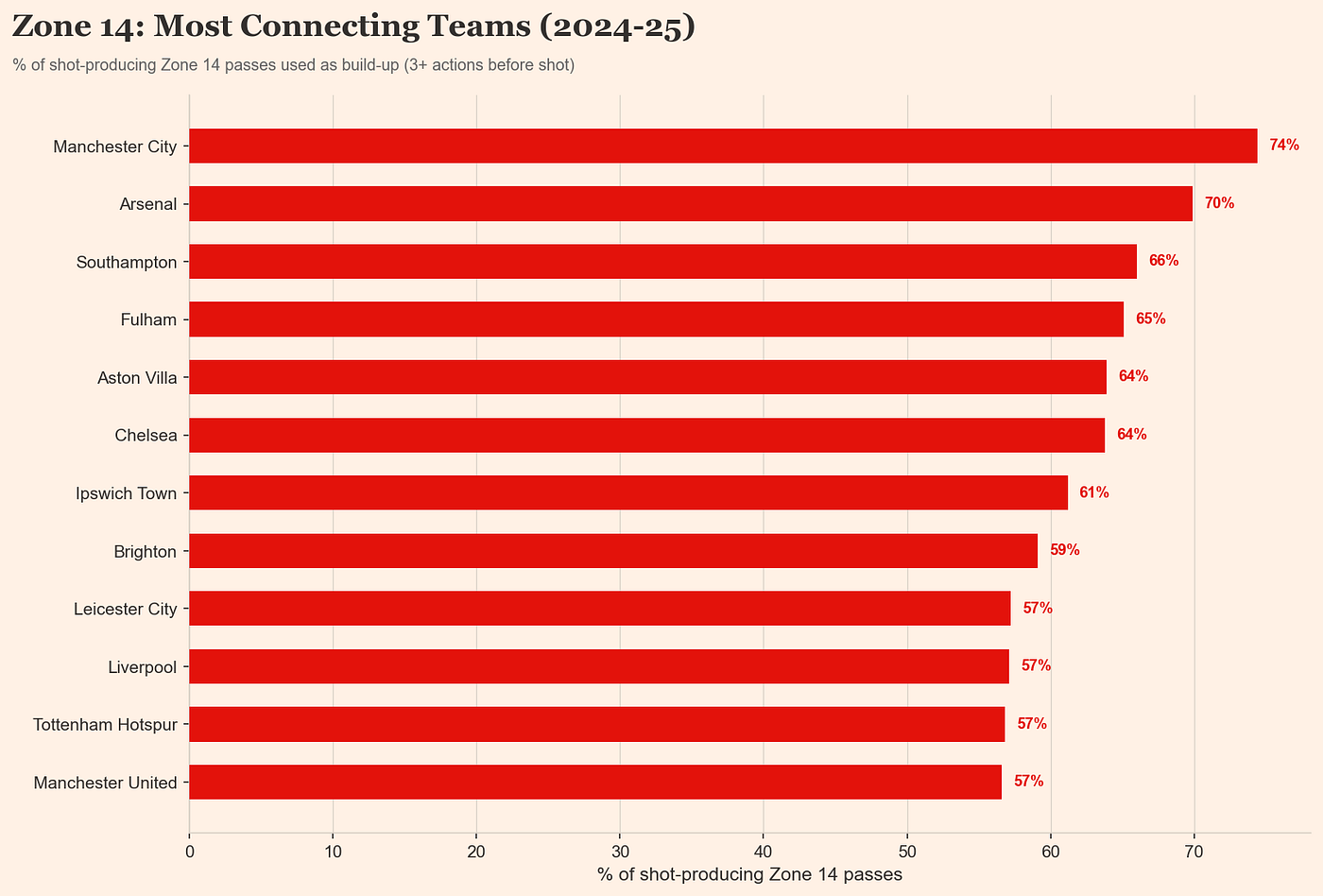
Here we see some top teams scoring high who are high on the passing game such as Manchester City, Arsenal and Liverpool. But we also teams like Southampton, Leicester City and Ipswich Town who were all relegaeted at the end of the season.
Final thoughts
So, has zone 14 really evolved? The short answer is that it hasn’t changed in the way I initially expected or perhaps even hoped for. The usage of zone 14 in the Premier League has remained remarkably stable over the last five seasons, and the long-standing idea that actions from this zone are four times more effective than those from the flanks simply does not hold up here. There is still an advantage, but it is far more modest. In that sense, this analysis does not tell a story of tactical disruption, but rather one of continuity, and accepting that is already an important outcome.
What has changed is not the relevance of zone 14, but its role within attacking sequences. The data supports the idea that zone 14 functions increasingly as a connecting zone rather than a pure creation zone. Fewer actions from this space lead directly to shots, while more possessions flow through it as part of longer, more controlled attacking phases. This also explains why high zone-14 connectivity is not limited to successful teams: both dominant possession sides and relegated teams appear near the top. Accessing zone 14, on its own, is not a measure of quality — what matters is what teams are able to do after reaching it.
Finally, this piece forced me to confront something about research and writing itself. The absence of a strong, dramatic change does not mean the analysis failed, it simply means the game did not move in the direction I anticipated. Trying to reshape the question to force a “better” result would have said more about my own need for validation than about football. Sometimes, stability is the finding. And perhaps that is the more honest place to end: zone 14 has not disappeared, nor has it transformed completely: it has quietly adapted within a game that resists simple truths.
References
Horn, R., & Williams, M. (2002). A look ahead to World Cup 2002: What do the last 40 years tell us? Insight, 5(2), 26–29.
LeoChan Performance Analysis. (2013, August 18). What is “Zone 14” in football? Retrieved from https://leochanperformanceanalysis.blogspot.com/2013/08/what-is-zone-14-in-football.html
Spielverlagerung.com. (n.d.). Zone 14 [Glossary entry]. Retrieved February 6, 2026, from https://spielverlagerung.com/glossary/pitch-zones/zone-14
Citation
admin. (2026, februari 7). The stagnation or evolution of zone 14?. Waltzing Analytics. https://waltzinganalytics.com/analysis/the-stagnation-or-evolution-of-zone-14/