In terms of football, the American soccer colleges system gives a great advantage into talent development. But, however, we don’t always see or feel how good a certain talent is, when we are not in that environment. It’s a great area to recruit from, but where do players actually go to right now?
In this analysis I will use different data sources to see the quality of the teams, the movements the players have made from NCAA Division I teams. The period I’m looking at is the fall 2022 season accompanied with a total 2022 power ranking — which helps me in selecting tiers.
Data: general performance data
For player-level data it’s important to stress that I’ve used Wyscout to identify all players in their respective conferences. This also means that the finals are left in this specific part of the analysis. By doing that I have a database of 7430 players across all Division I programs.
To make sure our selection is good and representative, in other words good to make comparisons — it’s important to make some selections:
- Minimal 500 minutes played
- Players with data collected — empty values not included
- Only Fall 2022 — without finals
- They are ranked into tiers of team strength (I will speak about this in section power rankings)
Having done that, I’m left with a database of 3153 players. That’s still a lot to be looking at but it gives a better idea of what said players can do in relation to other players.
Data: power rankings
In a way, Division I schools are already ranked, because they are Division I, as opposed to Division II and III, but still some schools are better than others. Their programs might be better, their players might develop in a certain way and/or they feed professionals to NWSL teams.
A way to rank these teams throughout the season is via power rankings. I’ve used the RPI for Division I Women’s Soccer ranking by Christopher Thomas. Like with any method, there are always flaws and imperfections, but I think this model is pretty spot on, on the level of the teams, the conferences and the regions within the United States.

Not only can you see which are the 10 best schools — we can also see which Conferences and regions are represented high up the power ranking. This gives us an idea of which teams/colleges are doing very well on the team-level and might give a good idea of where to recruitment from regarding level.
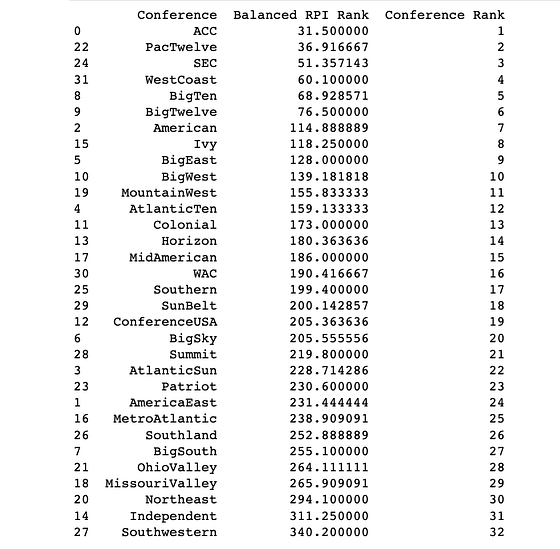
The next step for this is to take our power rankings for the teams and conferences and divide them into tiers. I’ve taken all teams in all of Division I and given them a Tier from 1–10. Basically percentages of 10% equalling a tier. With this tier system, I want to give an idea of which are the top performing squads relating to our power ranking and see if that also is reflected in the squad mutations after their college is finished.
Players movement
Of course, with the end of college, there comes the time for the next steps. Some might not pursue a career in football and move away from professional sports. Some players move in between their college period to another school. Those two categories are not taken into consideration when we try to measure transfers.


What you can see above are all players that moved after the 2022 Fall season and where they play now. I’ve given the orange colour to all players who have been drafted into the NWSL system and are now with NWSL teams. A few interesting things about the ones with NWSL teams:
- 21 players from Tier 1 teams
- 4 players from Tier 2 teams
- 2 players from Tier 3 teams
- 1 player from Tier 5 teams
A quick conclusion would be that NWSL teams do recruit not only from Division I teams but also like to reach out to those players predominantly in the best teams.
There are also players moving from the college system but aren’t drafted in the NWSL or don’t want to be. One important note to make here is that some foreign players choose to go to the US to study and play the game, but will move back to their country of origin after this period.

These are all non-NWSL teams with some college teams in there as well. As you can see there is a variety of leagues/countries out there: England, Germany, Australia, Iceland, Sweden, Denmark, Ireland, Portugal, Mexico and some others as well.
So are these players moving, from the same tiers as the NWSL ones?
- 14 players from Tier 1 teams
- 8 players from Tier 2 teams
- 5 players from Tier 3 teams
- 1 player from Tier 4 teams
- 1 player from Tier 5 teams
- 1 player from Tier 7 teams
- 3 players from Tier 8 teams
- 1 player from Tier 9 teams
- 2 players from Tier 10 teams
As you can see most players still come from Tier 1 teams, then Tier 2 teams — but it’s much more spread out and most likely from Tiers that the NWSL won’t look to draft from.
Ranking of leagues
When we want to rank leagues, it’s not only that we measure the quality of the best teams, but we measure competitiveness and the quality of the poorest teams as well, this gives us an overall idea about the different leagues. Then, more competitive leagues are ranked higher than leagues where relegation and/or the title is already put down on one team.
Having said that, often we can speak on 4 levels of tiers (multiple data suppliers tend to use a form of these tiers):
- Tier 1: NWSL, WSL, Frauen-Bundesliga, D1 Arkema
- Tier 2: Liga F, Serie A, A-League, Brasileiro, Damallsvenskan, Toppserien, W-League and Elitedivisionen
- Tier 3: 2. Frauen-Bundesliga, Championship, Liga BPI, Liga MX, Russian Super League, SWPL, Iceland
- Tier 4: NCAA, Belarus, Elitettan, WPL Ireland
When we look at NCAA, the overall level is that of a Tier 4 league. But, the strongest teams, especially in NCAA Tier 1,2 and 3 — might very much able on Tier 3 level, without developing. So which level do the NCAA players move to:
- 32 players move to Tier 1
- 9 players move to Tier 2
- 12 players move to Tier 3
- 6 players move to Tier 4
- 5 players move to lower levels or non-data level leagues.
Most players move to Tier 1, with NWSL being the most popular destination.
Final thoughts: mapping talent
As said above, it can be difficult to map talent from NCAA Division I colleges from outside the programs/schools. The programs can make sure that the players are not only of sufficient quality to be ready to be drafted, but it can also be a great advantage for clubs all over the world to take an interest in.
Clubs from different tiers and levels could really benefit from it and it seems like more and more clubs in Europe are tracking American talent as well. In the coming years, the recruitment from those women into the different tiers, will be an interesting one to follow.